Madrid: Two Models of Commercial Geography
Madrid's corporate geography is split between two distinct formats: the historic linear concentration along Paseo de la Castellana, which has functioned as the city's financial and institutional spine for over a century, and the purpose-built Cuatro Torres Business Area (CTBA) at the northern end of that same boulevard, developed in the early 2000s as a cluster of high-rise office towers.
La Castellana Corridor
The Paseo de la Castellana runs roughly north-south through Madrid, stretching from Atocha station in the south to the CTBA in the north. Along this corridor, several sub-zones have distinct commercial profiles. The Azca complex, roughly at the midpoint, contains the Torre Picasso (a 1988 skyscraper long associated with financial and legal tenants) and the ABC Serrano shopping centre. The area around Nuevos Ministerios and Cuzco stations concentrates government ministries and public administration buildings alongside private sector offices in mid-rise blocks.
The southern stretch of La Castellana, from Acción Recoletos to Plaza de Cibeles, hosts embassies, financial institutions and media companies. The Spanish National Securities Market Commission (CNMV) is headquartered in a building on Paseo de la Castellana, near other financial supervisory bodies.
Cuatro Torres Business Area (CTBA)
The CTBA developed on the site of the former Ciudad Deportiva del Real Madrid at the northern terminus of La Castellana. Its four towers—Torre de Cristal, Torre Espacio, Torre Sacyr (formerly Torre Caja Madrid) and Torre PwC (formerly Torre Agbar Madrid)—house multinational professional services firms, energy companies, telecommunications operators and financial institutions. The complex is served by the Begoña metro station on line 10.
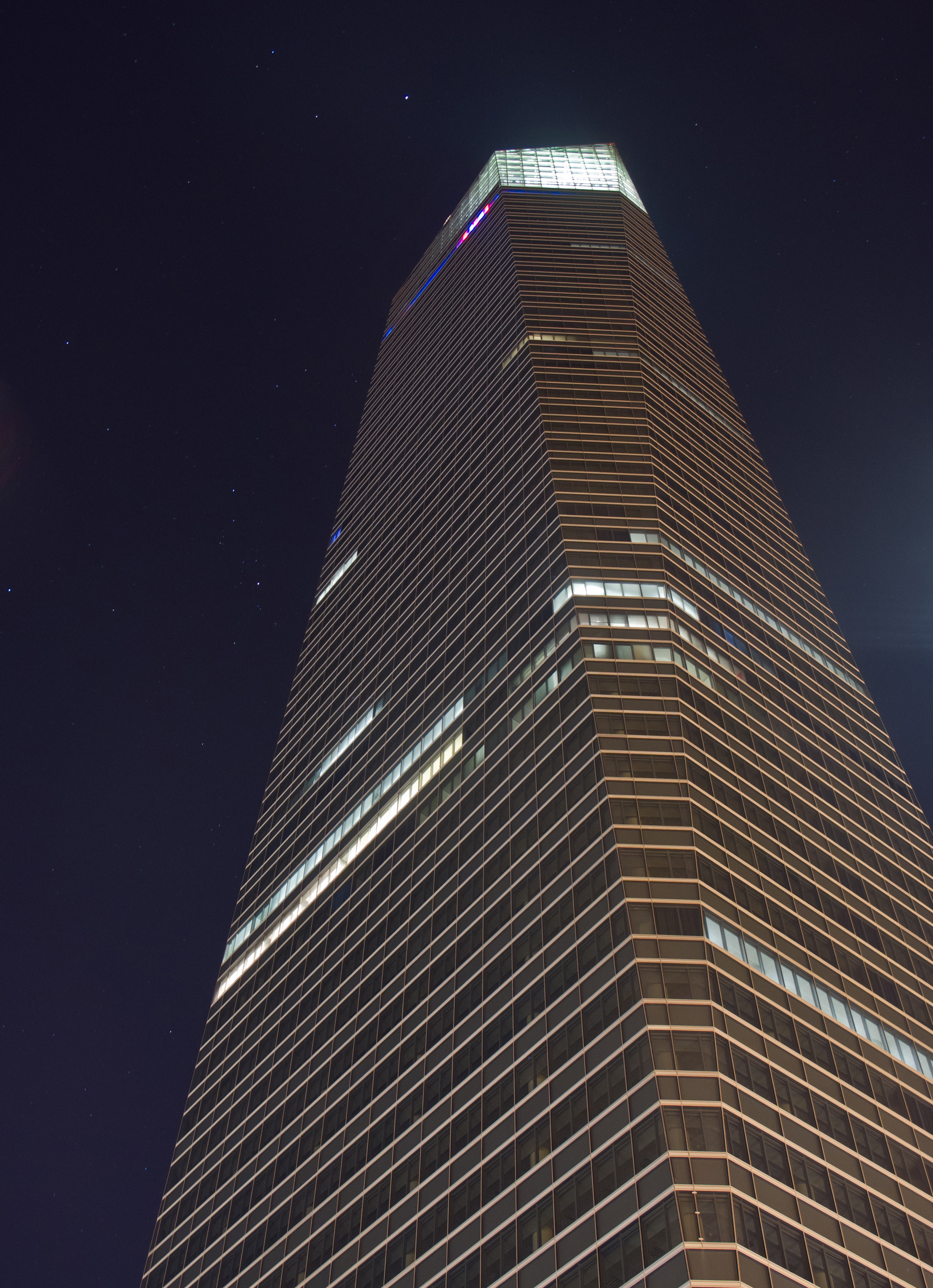
Torre de Cristal, part of the Cuatro Torres Business Area at the northern end of Paseo de la Castellana. Source: Wikimedia Commons (CC BY-SA 3.0)
The CTBA's amenities are primarily oriented around the needs of the office population rather than visitors. Several business hotels are located within walking distance or a short taxi ride, including properties that cater to the extended-stay and serviced-apartment segments. The NH Collection Madrid Eurobuilding and the Hilton Madrid Airport are both frequently used by CTBA-bound corporate travellers.
Co-working in Madrid
Madrid's co-working sector is concentrated in three areas: the Malasaña–Chueca zone, which hosts smaller creative-sector operators; the Salamanca district, which caters to legal and consultancy clients; and increasingly within CTBA itself, where several towers have introduced flexible workspace floors alongside traditional long-let office suites. Operators including WeWork, IWG (Regus/Spaces) and local chains such as Loom maintain multi-location networks across the city.
Barcelona: 22@ and the Eixample Financial Core
Barcelona's business geography differs from Madrid's in one significant way: the city's most dynamic commercial growth area is a former industrial neighbourhood rather than a purpose-built financial district. The 22@ district in Poblenou, sometimes called the "Innovation District", has been the primary focus of commercial real estate development in Barcelona since the area was rezoned at the start of the 2000s.
The 22@ Innovation District
The designation "22@" refers to the city's zoning code that replaced the prior industrial classification (22a) of Poblenou with a mixed-use designation allowing technology, creative and media companies alongside housing and educational facilities. Practically, the district has attracted the Barcelona offices of major technology companies, digital media groups, architecture firms and health-technology businesses.
The physical character of 22@ is a mix of converted industrial buildings (the brick factory buildings known as naus are frequently retained and adapted) and contemporary office blocks. This combination results in a district that looks unlike a conventional financial district, with ground-floor cafes, cycling infrastructure and public spaces woven between office addresses. The CCIB congress centre (discussed in the Convention Centres article) is located at the northern boundary of the district, near the seafront.
Transport access to 22@
The district is served by metro lines L4 (Llacuna and Poble Nou stops) and L1 (Marina stop at the western boundary). The T4 tram line runs along Diagonal, just north of the district. From Barcelona Sants station, the main high-speed rail terminal, the journey is approximately 20 minutes by metro. From Barcelona El Prat Airport, the Aerobus service connects to central Barcelona in around 35 minutes, with metro onwards.
The Eixample Financial and Legal Cluster
Barcelona's established financial and legal institutions are concentrated in the Eixample district, particularly along Passeig de Gràcia, Diagonal and the blocks between them known informally as the "Quadrat d'Or" (Golden Square). This area houses the Barcelona Stock Exchange (Borsa de Valors de Barcelona), major Spanish and international bank branches, and the offices of large commercial law firms.
The Eixample has a higher density of luxury and four-star business hotels than 22@, and its central position within the city makes it practical for meetings that draw attendees from multiple locations. The main taxi ranks and many hotel concierge services assume Eixample as the default base for business visitors.
Co-working in Barcelona
Barcelona's co-working landscape is closely tied to the 22@ district, where a number of larger shared workspace venues occupy ground and lower floors of newer developments. Outside 22@, the Raval and Poble Sec areas host smaller independent operators, while the Eixample concentrates premium business centre providers. The city also has several sector-specific co-working venues, including those orientated around health-tech and fashion-related businesses.
Choosing Between Cities for Corporate Events
For event organisers selecting between Madrid and Barcelona, several practical distinctions apply. Madrid offers the larger venue infrastructure through IFEMA and direct access to CTBA for meetings with government and energy sector stakeholders. Barcelona's convention centres and the CCIB are better positioned for technology, health and media sectors, which are more densely represented in the city's business geography.
Accommodation pricing and availability differ substantially during peak event seasons. Mobile World Congress in late February and Alimentaria in April historically create accommodation shortages across Barcelona that push secondary bookings to cities like Tarragona and even Girona. Madrid's IFEMA calendar is less concentrated, distributing pressure across more months of the year.
District maps and tenant directories: The Barcelona City Council publishes an annual directory of 22@ district tenants. The Madrid City Council maintains an online portal for the CTBA area. Both are publicly accessible reference points for verifying company locations before arranging visits.